
Blue light can trigger or worsen headaches, but mainly in people who already run light-sensitive, especially during migraine. It rarely causes headaches on its own in everyone else. The stronger culprit for most desk workers is digital eye strain, a separate but overlapping problem that blue light exposure tends to compound. If you’re photophobia or migraine-prone, a 20-20-20 routine and warmer screen settings in the evening are worth testing before anything more clinical.
TL;DR:
Blue light can lower pain thresholds in migraine sufferers but is unlikely to cause headaches in most people, with effects mainly seen in light-sensitive individuals.
Short-wavelength-emitting screens and flicker from PWM LED backlights can contribute to headache triggers, especially if glare and eye strain are also present.
Implementing the 20-20-20 rule, reducing glare, and warming display settings in the evening can help prevent light-triggered headaches and improve sleep quality.
Clinically supported tinted lenses like FL-41 and notch filters may reduce migraines and photophobia, while generic blue-light glasses show inconsistent benefits.
Immediate medical attention is necessary for sudden severe headaches with neurological symptoms, and tracking triggers helps identify if light exposure contributes to recurrent headaches.
Table of Contents
Can Blue Light Cause Headaches? The Mechanism Behind It
Blue light doesn’t cause pain the way a burn or a bruise does. It works through a specific set of retinal cells called intrinsically photosensitive retinal ganglion cells, or ipRGCs, which contain a light-sensitive protein called melanopsin. Melanopsin responds most strongly to short wavelengths, the blue and blue-green part of the visible spectrum. These cells don’t just help regulate your circadian clock. Some of them project directly into pain-processing circuits in the brainstem, specifically the trigeminal nociceptive pathway that also drives migraine pain.
That wiring is why bright, blue-heavy light can lower a migraine sufferer’s pain threshold almost instantly, according to research on ipRGC activity and photophobia. The eye is essentially handing the brain’s pain circuitry a signal it wasn’t built to ignore.
There are two distinct ways light-related headaches show up, and mixing them together is where a lot of confusion starts:
-
Direct photic triggers: light itself provokes or intensifies pain, most visible as photophobia during a migraine attack.
-
Indirect effects: screen use disrupts sleep timing, strains the eyes through reduced blinking and fixed focal distance, or both, and the resulting fatigue shows up as a headache hours later.
The research doesn’t support a blanket claim that blue light causes headaches in the general population. A narrative review of blue light’s ocular and systemic effects found the picture is more nuanced: spectral tuning appears to help with circadian protection and some fatigue markers, but blue-filtering lenses showed no consistent improvement in dry-eye signs during a 120-minute reading task. Blue light is a real trigger for a specific, light-sensitive subset of people. For everyone else, it’s usually one contributor among several.
Signs Your Headaches Are Light-Related
A few patterns tend to show up together when light, rather than posture or dehydration, is the main driver.
-
Timing: the headache starts during or shortly after screen use, or gets noticeably worse under bright overhead lighting or direct sun.
-
Photophobia: light itself feels painful, not just annoying, and dimming the room brings real relief.
-
Throbbing, one-sided pain: especially if it echoes typical migraine location and quality rather than the tight band of a tension headache.
-
Eye-related symptoms: blurred vision, dry or gritty eyes, and a burning sensation that tracks with digital eye strain.
-
Neck and shoulder tension: often present alongside eye strain, since people crane toward screens as fatigue sets in.
If you notice reduced blink rate and dry eyes stacking on top of the headache pattern, you’re likely dealing with digital eye strain first, with light sensitivity making it worse.
Where the Triggers Actually Come From
Screens and LEDs emit light that’s disproportionately rich in short wavelengths compared to older light sources like incandescent bulbs, which is precisely the range melanopsin responds to most.
But spectral content isn’t the only issue. Two other technical factors matter just as much:
-
PWM flicker: many LED displays dim their backlight using pulse-width modulation, an invisible on-off flicker that some people perceive as headache-inducing strain even when they can’t consciously see it flickering, according to reporting on LED lights and headache triggers.
-
Glare and dimming artifacts: reflections off glossy screens and inconsistent brightness force the eye to keep re-adjusting focus.
-
Fluorescent fixtures and bright sunlight: both push a similar short-wavelength load, meaning the trigger isn’t limited to screens at all.
How to Prevent and Relieve Light-Triggered Headaches
Start with distance and timing. The American Optometric Association’s 20-20-20 rule recommends looking at something 20 feet away for 20 seconds every 20 minutes, with your monitor positioned 20 to 28 inches from your eyes and its center angled 15 to 20 degrees below eye level.
-
Set a break schedule you’ll actually keep. A recurring timer beats willpower. Pair it with blink reminders, since screen focus quietly cuts blink rate and dries out the eyes.
-
Use lubricating eye drops if dryness is part of the pattern. This addresses the eye-strain half of the problem directly, separate from light sensitivity.
-
Check your posture and monitor height together. Neck tension from looking up or down at a screen often masquerades as a light-triggered headache.
-
Warm up your display in the evening. Reducing short-wavelength output a few hours before bed supports sleep timing without forcing you to stop working. A tool like Lumina Filter’s Mac display filtering handles this automatically as daylight fades.
-
Consider green light exposure for migraine, but only with a clinician’s input. A small trial found green LED exposure reduced headache days and intensity in a limited group, per the same reporting on LED-related headache triggers, though the evidence base is still thin.
-
Reduce glare and check your refresh rate. Higher refresh-rate displays and DC dimming (where your monitor supports it) cut down on the flicker that dimming systems otherwise introduce.
Pro Tip: If you can’t tell whether it’s the screen or the room lighting, cover your monitor for ten minutes during a headache and see if the light sensitivity eases before the pain does. That order tells you which one is leading.
Do Blue-Light-Blocking Glasses and Filters Actually Work?
The evidence splits sharply depending on what you’re wearing.

Precision-tinted lenses, particularly FL-41 tints and optical notch filters designed to block narrow migraine-relevant wavelengths, show real benefit in clinical reports for reducing migraine frequency and photophobia in specific patients, according to the National Headache Foundation. These are engineered around actual spectral triggers, not general-purpose amber tinting.
Consumer blue-light glasses are a different story. Their spectral filtering varies wildly between brands, and the same narrative review noted above found no consistent improvement in dry-eye symptoms during short-term reading tasks. If a pair of blue-light glasses helps you, it may be working, but there’s no reliable standard guaranteeing that any given pair will.
-
FL-41 and notch filters: targeted, clinically supported for some migraine patients.
-
Generic consumer blue-light glasses: inconsistent spectra, mixed evidence for eye strain or sleep.
-
Display-level spectral tuning: adjusts the light source itself rather than filtering it after the fact, which keeps colors and contrast intact while cutting short-wavelength output.
Display-level filtering and lens tinting aren’t competing solutions so much as different tools for different problems. One changes the emitted light. The other changes what reaches your eye.
When to See a Doctor About Screen-Triggered Headaches
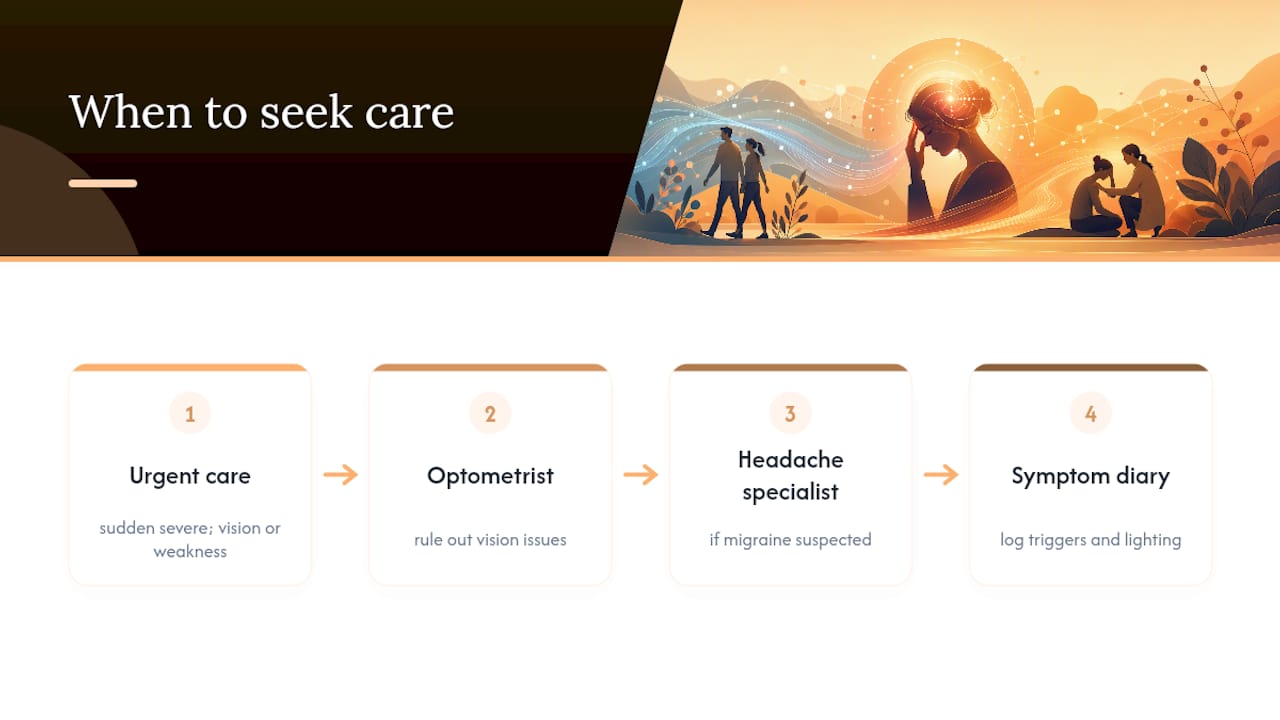
Seek urgent care for a sudden, severe headache unlike your usual pattern, or one with vision changes, confusion, or weakness on one side. For recurring photophobia or headaches tied to screen use, start with an optometrist to rule out vision correction issues, then a neurologist or headache specialist if migraine is suspected. Track your triggers in a symptom diary, noting how headaches respond to lighting changes.
Testing Blue Light’s Role in Your Own Headaches
Log your headaches and light exposure for a week before changing anything. Then run a focused two-week trial: 20-20-20 breaks, a warmer evening display, and blink reminders together. If frequency or intensity drops, light was likely a factor. If nothing improves, or symptoms are severe, loop in a clinician rather than keep guessing on your own.
— Dave
A Practical Option: Lumina Filter for Screen-Related Headaches
If screens are part of your headache pattern, the fix that actually sticks is one you don’t have to think about twice a day. Lumina Filter works at the display level on Mac and Windows, adjusting screen warmth in real time instead of layering a generic night mode over everything. It’s built for people already doing the 20-20-20 routine and the ergonomic fixes, who want their screen doing part of the work too.

The filter strength is adjustable to your environment and time of day, with auto circadian sync shifting warmth as daylight changes, and every setting is validated through spectrometer-backed testing rather than a rough color-temperature slider. It won’t replace a neurologist if your headaches are severe or worsening, and it isn’t a substitute for the breaks and blink habits covered above. But paired with them, it removes one variable you’d otherwise have to manage manually every evening. Start the free 7-day trial and see whether a warmer screen changes your headache pattern within a week.
This article is general information, not a substitute for advice from a qualified doctor. Consult a qualified healthcare professional about your own circumstances before acting on anything here.