
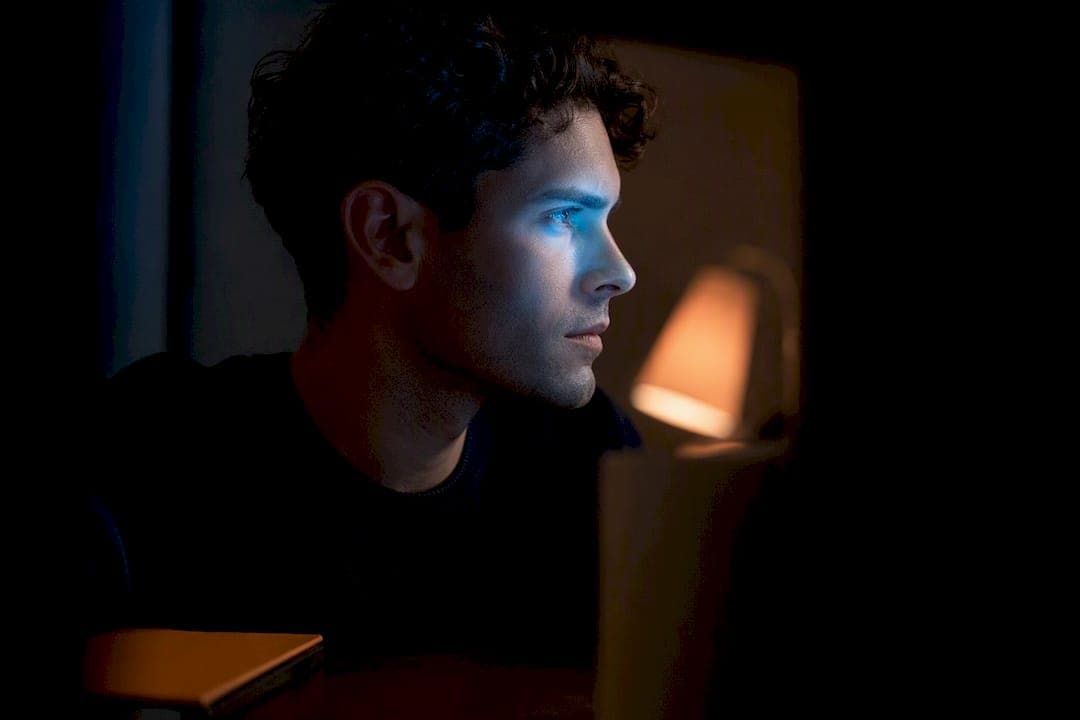
Yes, exposure to blue-enriched light in the evening suppresses melatonin and delays your internal sleep clock. Suppression can begin within about an hour of exposure and, depending on the light's spectrum and intensity, extend into the night and even blunt melatonin levels the next morning. The size of the effect depends heavily on melanopic irradiance rather than raw brightness. Timing your light exposure, warming up your screens, and using display-level filtering can substantially cut the impact.
TL;DR:
- Even moderate blue-enriched light exposure within the first hour of use can significantly suppress melatonin and delay your internal sleep clock.
- Melanopic irradiance, not brightness alone, determines the impact of light on melatonin suppression, with a threshold around 14 microwatts per square centimeter for half-maximal effect.
- Blue wavelengths around 464 nanometers suppress melatonin for longer and more deeply than green or red light, with spectrum playing a crucial role.
- Using display filters that target melanopic content offers a practical way to reduce circadian disruption without sacrificing color accuracy or your screen’s appearance.
- Prioritizing early evening light management, including dimming, warm lighting, and filters, can substantially improve sleep quality and hormonal balance.
Table of Contents
- How Blue Light Suppresses Melatonin: Biology and Key Metrics
- What the Studies Show: Dose-Response and Real-World Evidence
- Practical Steps to Reduce Melatonin Suppression From Blue Light
- Vendor-Level Evidence and Real-World Testing
- Balancing Evening Screen Use With Sleep Health
- A Practical Option: Display-Level Blue Light Filtering
- Sources
How Blue Light Suppresses Melatonin: Biology and Key Metrics
The link between melatonin and blue light runs through a set of light-sensing cells most people have never heard of. Your eyes contain intrinsically photosensitive retinal ganglion cells, or ipRGCs, which hold a photopigment called melanopsin. Melanopsin is most sensitive to short-wavelength light, roughly in the blue-cyan range, and it doesn't feed your visual image at all. Instead, it reports ambient light levels straight to the suprachiasmatic nucleus, the brain's master clock, which then signals the pineal gland to hold back melatonin release.
This is why a bright blue-heavy monitor at 11 p.m. does something a dim reading lamp doesn't: it tells your brain it's still daytime, even though you know better.
Researchers describe this circadian pathway using a specific metric: melanopic equivalent daylight illuminance, or melanopic EDI (mEDI). This number matters more than the photopic lux reading your phone's brightness sensor gives you, because two light sources with identical lux values can have very different effects on melatonin depending on their spectral makeup. A Communications Biology study on evening display light found that melanopic irradiance, not photopic lux, predicted sleep latency, melatonin suppression, and alertness with far more precision. That distinction is the whole reason "just dim your screen" advice is incomplete. A dim screen with a blue-heavy spectrum can still carry a high mEDI value.
The typical time course looks like this:
- Within the first hour of exposure to blue-enriched light, melatonin secretion starts to drop measurably.
- Suppression persists as long as exposure continues, particularly with continuous screen or overhead LED use.
- Circadian phase delay follows, pushing your body's internal sense of "nighttime" later.
- Recovery begins once blue-heavy light is removed, though the timeline depends on the dose and duration of prior exposure.
Melanopic irradiance, in plain terms, is a way to measure how "circadian-active" a light source is, not just how bright it looks to your eye. Two lamps can look equally warm-toned but have very different melanopic footprints depending on their exact spectral output. This is the terminology gap that trips up most consumer advice: color temperature (measured in Kelvin) is a rough proxy, but melanopic irradiance is the metric that actually correlates with melatonin and sleep outcomes.
What the Studies Show: Dose-Response and Real-World Evidence
The evidence connecting screens, lamps, and melatonin suppression isn't a single study. It's a stack of controlled experiments that converge on the same conclusion, with more precision than most sleep advice gets credit for.
The clearest dose-response data comes from a controlled light exposure trial that measured plasma melatonin against narrowband blue LED intensity. Researchers found a sigmoidal fluence-response curve, meaning suppression scales with light dose up to a saturation point, with an ED50 around 14 microwatts per square centimeter for wavelengths in the 446 to 477 nanometer range. In practical terms, you don't need blinding brightness to trigger meaningful suppression. Even moderate blue-wavelength exposure can produce a measurable hormonal response.
A separate experiment comparing colors directly reinforces this. Blue LED light at a peak wavelength near 464 nanometers suppressed salivary melatonin within one hour and kept it suppressed across a full three-hour exposure window. Red light, tested under the same conditions, allowed significant melatonin rebound after two to three hours. The spectrum mattered more than the exposure duration.
Blue light suppressed melatonin for a longer period and shifted circadian rhythm by twice as much compared to green light of the same brightness, according to Harvard Health's review of blue light research. That gap between two colors of equal brightness is the clearest demonstration that spectrum, not just intensity, drives the circadian effect.
A dose-response study of narrowband blue LED exposure identified an ED50 near 14 μW/cm², meaning half-maximal melatonin suppression occurred at that intensity in the tested wavelength band. That figure gives researchers a benchmark for how little light is actually required to move the needle.
Beyond the lab, the picture gets messier but points the same direction. Evening screen use, even at everyday brightness levels, has been linked to:
- Roughly doubled sleep-onset latency in some observational comparisons of screen users versus non-users before bed.
- Reduced time spent in REM and slow-wave sleep stages, the phases most associated with memory consolidation and physical recovery.
- Morning carryover effects, where melatonin levels remain suppressed into the next day rather than resetting overnight.
Worth noting: most of these findings come from a mix of tightly controlled lab studies (small samples, hours-long light exposure protocols) and looser real-world observational data. The lab studies isolate spectrum and dose with precision but often use small cohorts, sometimes a few dozen participants. The real-world data captures lived behavior but can't fully separate blue light's biological effect from the mental stimulation of scrolling, gaming, or work stress before bed. Both strands point the same direction, but the field still lacks a large, long-term trial tracking chronic nightly screen exposure against health outcomes over years.
Practical Steps to Reduce Melatonin Suppression From Blue Light
You don't need to overhaul your entire evening to blunt this effect. You need a short list of changes ranked by how much they actually move the needle, applied in the order that fits your constraints.
- Shift your highest-intensity light exposure earlier in the evening. If you're going to be under bright screens or overhead LEDs, do it before 8 or 9 p.m. rather than right before bed. The dose-response research shows suppression tracks closely with both intensity and timing relative to your sleep window.
- Switch your evening room lighting to warm or tunable bulbs. Based on the suppression data from home lighting studies, a warm 2100K setting can cut estimated melatonin suppression to near zero compared to cool white LEDs.
- Reduce screen brightness in the hour or two before bed, but don't stop there. Dimming alone leaves melanopic irradiance higher than most people assume, since sensitivity to short-wavelength light stays elevated even at lower brightness.
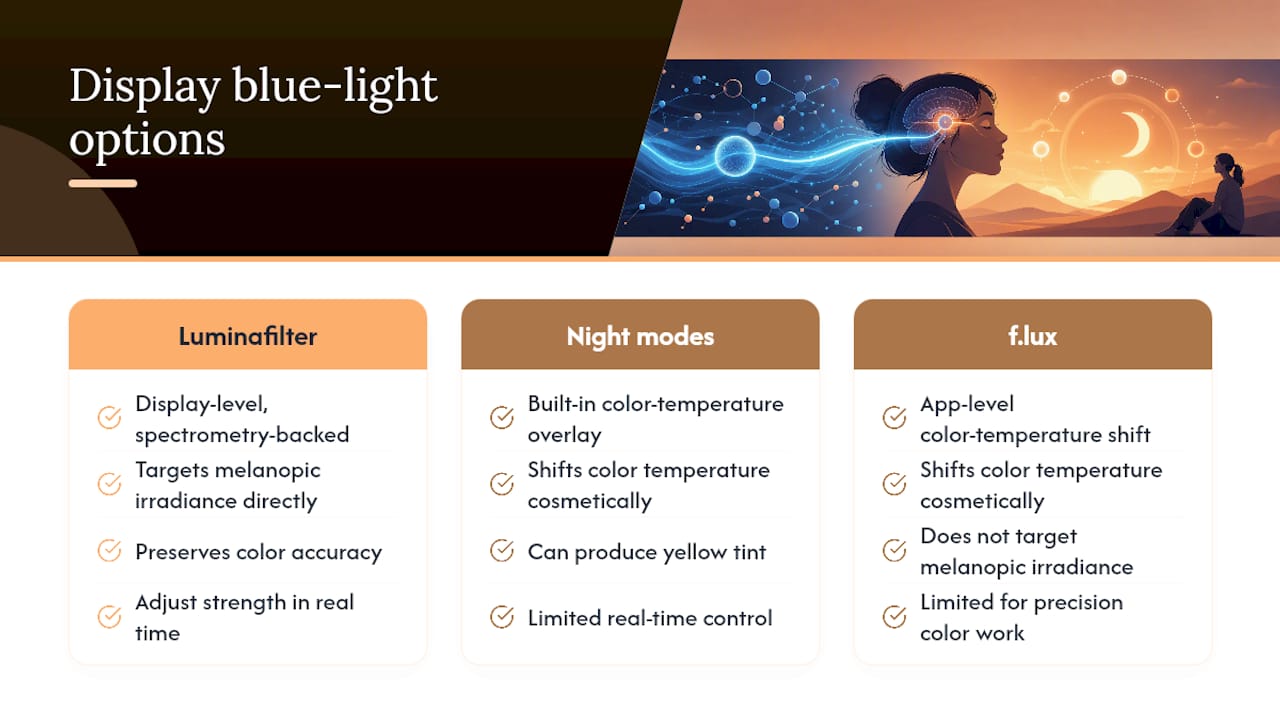
- Use a display-level filter that reduces melanopic content, not just a basic night-mode color shift. Standard night modes often only nudge color temperature slightly and don't meaningfully reduce the melanopic irradiance your ipRGCs respond to.
- Get bright light exposure earlier in the day. A strong daytime light signal, ideally natural sunlight, reinforces your circadian rhythm and makes evening light management more effective, since your clock is better anchored to begin with.
- Keep a consistent sleep and wake schedule. Irregular timing amplifies the disruptive effect of any given light exposure, because your circadian system is working against a moving target.
- Limit highly stimulating content in the final hour before bed, separate from the light-source question entirely, since mental arousal and blue light exposure often stack on the same device.
Pro Tip: If you can only make one change tonight, prioritize the display filter over swapping light bulbs. Screens sit closer to your eyes than room lighting, which means their melanopic impact per lux is usually higher, and a software-level fix takes under a minute to set up.
If you're a night owl who can't shift your schedule earlier, or a student cramming after 10 p.m., the priority order still holds. Do what you can from the top of the list down, and treat the display filter as your highest-leverage single move given how little time it takes to implement.
Vendor-Level Evidence and Real-World Testing
Luminafilter's engineering team validated its filtering approach using spectrometry, measuring the actual spectral power distribution emitted by a display before and after filtering, rather than relying on a color temperature slider alone. That distinction matters because two screens can report the same Kelvin value while emitting very different amounts of light in the 480 to 500 nanometer band that melanopsin responds to most strongly.
Generic night modes typically apply a uniform orange tint across the whole display. Display-level filtering, by contrast, targets the specific wavelength range tied to circadian disruption while leaving the rest of the color spectrum closer to intact. That's the same principle researchers point to when they note that selectively modulating melanopic irradiance can protect circadian signaling without fully distorting how a screen looks.
A few points worth keeping in mind about this approach:
- Spectrometry testing measures actual emitted wavelengths, not just the color temperature setting reported by the operating system.
- Filtering strength can be adjusted for time of day and environment, since your circadian sensitivity to light isn't constant across the evening.
- Reducing melanopic irradiance at the display level addresses the root signal your ipRGCs detect, rather than just changing how the screen looks to your eye.
Balancing Evening Screen Use With Sleep Health
Most advice on this topic pretends everyone can just stop using screens after sunset. That's not realistic for a night-shift worker, a student finishing homework at 11 p.m., or anyone streaming a show to unwind. The honest approach is layered: shift what light exposure you can, warm up what you can't shift, and filter what's left. Behavioral changes alone tend to underperform, and technical fixes alone miss the timing piece, but combined, they consistently produce the biggest measured improvements in sleep latency and melatonin retention.
— Dave
A Practical Option: Display-Level Blue Light Filtering
If you've read this far, you already know that dimming your screen or flipping on a built-in night mode only addresses part of the problem. Luminafilter is built specifically to target the melanopic content in your display's light output, not just shift its color temperature cosmetically.
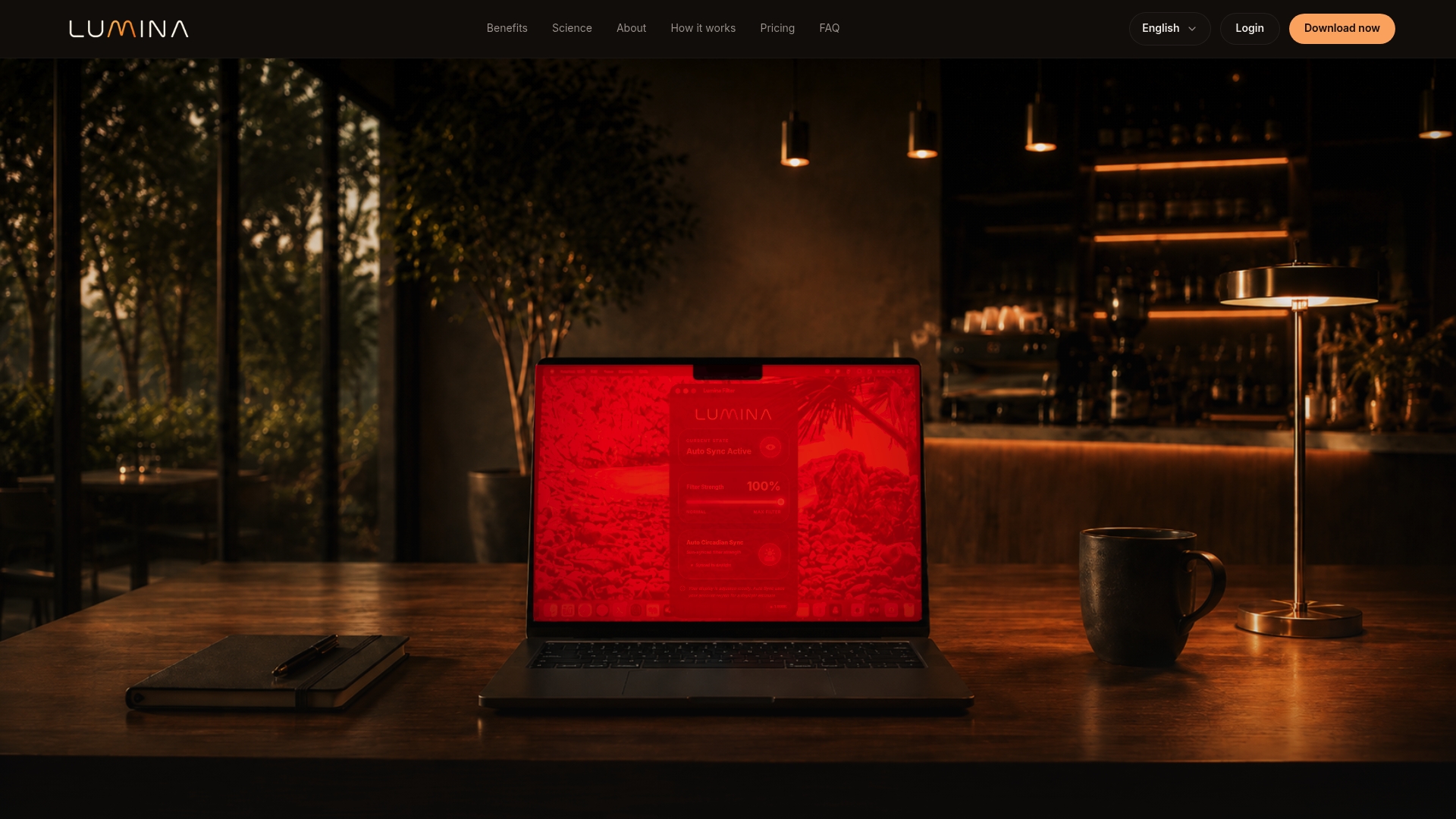
Unlike standard night modes, Luminafilter operates at the display level, adjusting screen warmth in real time based on spectrometry-backed testing rather than a generic orange overlay. You can dial the filter strength up for late-night work sessions and back off during the day, without sacrificing the color accuracy you need for photo editing, design work, or just watching something without a yellow tint over everything. It works across both Mac and Windows systems, and if you're currently using something like f.lux, Luminafilter's display-level approach goes further by targeting melanopic irradiance directly rather than a simple color-temperature shift. For a deeper look at the testing methodology behind it, the science page breaks down the spectrometry data in detail.
If evening screen time isn't going away, which it usually isn't, the practical move is to start a free 7-day trial tonight and see how your sleep latency feels by the end of the week.
Sources
For readers who want the original data: the Communications Biology melanopic irradiance study, the dose-response LED trial, and Harvard Health's blue light overview cover the mechanisms and evidence in full. For behavior-focused strategies beyond lighting, see this guide on reducing screen time.
This article is general information, not a substitute for advice from a qualified doctor. Consult a qualified healthcare professional about your own circumstances before acting on anything here.
- Comparative Effects of Red and Blue LED Light on Melatonin Levels During Three-Hour Exposure in Healthy Adults
- Melanopic irradiance defines the impact of evening display light on sleep latency, melatonin and alertness | Communications Biology
- Blue light has a dark side | Harvard Health
- Blue light from light-emitting diodes elicits a dose-dependent suppression of melatonin in humans